
The 14th Responsible Business Research Conference 2026 at Tampere University: Reflections and highlights
- Neha Neha
- Apr 30
- 4 min read
Updated: May 7
As in many previous years, the RESPMAN Research Group once again provided an excellent platform for young researchers, leading scholars, and business practitioners to share, discuss, and reflect on their research findings, insights, and future directions for development. This conference serves as an important gateway for doctoral students and early-career researchers to receive feedback and gain new ideas for their ongoing work. In addition, it offers a friendly and inclusive environment with a high level of engagement among scholars in the responsible business research community. It is not merely an event, but a tradition among the research group members, who are committed to make a societal contribution, and invite scholars and friends from all around the world to Tampere. This year marked the 14th edition of the conference, continuing this valuable tradition.
The Dean of the Faculty of Business and Management, Professor Marko Seppänen opened the conference with remarks on responsible business research, highlighting research impact and ending his speech with a thought-provoking question: How can we change human behavior? I believe every responsible researcher should reflect on this question before starting any research project, because it can help connect the researcher with the social implications and values underlying the work. In this way, it can guide and inspire the entire research process.
The keynote speech was given by Professor Harry Van Buren, a well-known scholar who has actively advanced research on human rights in the field of business. His high level of wisdom and deep sense of responsibility as a researcher are reflected in both his scientific work and professional life. This year, he delivered the keynote speech on one of the central themes of his research: Who and what should matter: The problem of marginalization and lack of voice in business ethics. Professor Van Buren highlighted a very crucial and persistent issue in business: stakeholder marginalization is a practical problem. Marginalized stakeholders are not less valuable in real life; they are just as important and crucial as any primary stakeholder, and their marginalization is a business issue, too.
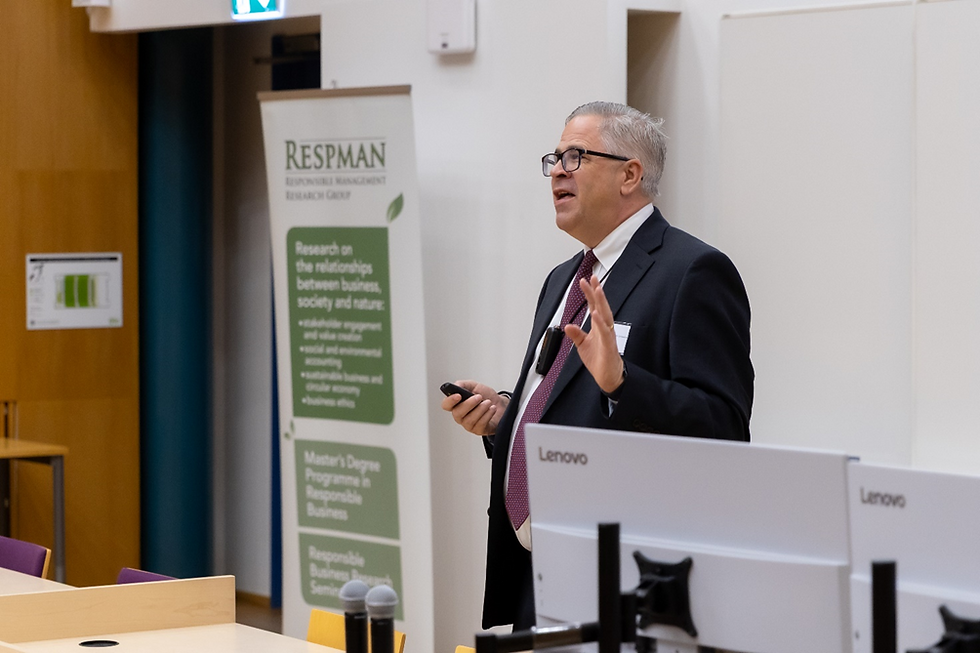
This led me to reflect on how business originally emerged to serve society, yet after centuries of industrialization, the narrative sometimes seems to have shifted toward the idea that society exists for business. Business depends on society for its development, while it may also contribute to social and environmental harm in the pursuit of survival and growth. We are all facing the consequences of this shift. Money has always been a key force in society; however, the power of money also exists because of society. This raises an important question: How and why have societal actors been pushed to the periphery of business?
An inspiring quote shared by Professor Harry touched me: “Not everything that is faced can be changed. But nothing can be changed until it is faced.” – James A. Baldwin
A similar issue exists with the natural environment. Business cannot survive without natural resources, because it transforms those resources into products for human consumption. Yet nature as a stakeholder is still not widely accepted from a traditional business perspective. During the conference, I observed that responsible business researchers are doing important work in bringing this narrative to the forefront. Research in this field is flourishing, but whether it will truly shape business practice remains uncertain unless we also change our human mindsets.
A human-centered approach has also been identified as a major danger to marginalized non-human stakeholders. Some researchers suggested that building a connection with nature is more important than many of our other relationships. I would argue that there is always already a connection between humans and nature; rather than focusing on building it, we should focus on understanding, recognizing and flourishing with it. We cannot separate ourselves from nature, because we are all integral parts of the same system and cosmos.

The human mind is naturally curious and constantly seeks to identify what is unique and different. There is nothing wrong with that. The problem arises when humans begin to believe that they can create something entirely separate from what already exists. In many ways, we do not create from nothing; rather, we discover and transform what is already present. Unfortunately, we are also capable of destroying many things because of changes in our mindset, especially when we begin to believe that the whole Earth exists solely for us. That is a myth. And if, even for a moment, we accept such a selfish mindset, then we must also take responsibility for what is happening on this planet now and in the future.
My reflections may go somewhat beyond the conference theme, but I strongly believe that we are responsible for our planet, for the future generations, and for the present living beings. Our actions should therefore carry accountability and responsibility. We should be able to answer the question of what we did when we had both the opportunity and the power to act. There are so many responsibilities and so little time, yet people with strong values and high ethical standards continue to support a rapidly changing society, business world, and the environment.

The final session of the conference highlighted the crucial issue of planetary boundaries. Different perspectives were presented in the panel discussion, which brought together an excellent group of panelists representing academic research, technical expertise, and business practice. This valuable combination of views encouraged the conference participants to think more deeply about what we, as researchers, can do to ensure that our work is translated into nature-inclusive practices. Communicating research findings in clear and accessible language was identified as a key factor in creating real societal impact. Such communication can shape public values, change mindsets, and support society in coping with current and future challenges in a responsible and sustainable way. Responsibility is the key foundation of a robust social system.
I would like to express my sincere gratitude to the conference organizing team, Professor Johanna Kujala for leading the efforts, Professor Harry Van Buren for his contribution, Faculty of Management and Business and Tampere University for their support, and last but not least, the Foundation for Economic Education (Liikesivistysrahasto) for financial endorsement for the conference.
Neha Neha
Postdoctoral Researcher
Faculty of Management and Business
Tampere University


Comments